Showing posts with label Arts and Entertainment. Show all posts

17 November 2011

Unrecognzied Art Amidst a Chaotic Chicago

Photo courtesy of K. Hansen.
Photoshop manipulation by B. Goble.


By Blake Goble

To walk anymore in Chicago is like a game of artful bombardment. Light after light… stopping, going… just trying to ignore all distractions to get to a destination. But look at what presents itself to you every five feet. Stop, and look around.

See that? The newly designed, spiffy looking new sign resting atop a CTA bus stop on Michigan Avenue? Neat, right? Those multi-colored or minimalist flyers at North and Damen and Milwaukee showcasing the latest musical act looking for a local audience? The sign that actually makes sense and looks good as you're crossing the street? No one leaves donations, or feels the need to praise their creators or put these informational pieces up at the Art Institute. Hell, most people don't even notice these things at all. Yet, all these visuals, every one of them…are art envisioned and created by designers, engineers and artists.

This constant barrage of imagery is not the attention-grabbing, well known sculptures or paintings that we notice like the Daley Picasso or that big, loud Marilyn on display. I am talking about the under-recognized gems of art around Chicago, cleverly disguised as signs. The problem though, is that's there so much on display, it's hard to appreciate anything.

"It's a cacophony versus a chorus", says George Aye, an Assistant Professor at the School for the Art Institute of Chicago (SAIC). Aye, a trained eye whose "Smart Cities" course was an examination of information systems, and how to make them better sees this work every day, and like most other people, tends to ignore it. "It's hard to tell when the good work is there, because the crappy stuff is always there, everywhere!"

Perhaps this work could be better, more streamlined and pointed. Or, more importantly, signs and public art could be more attractive. A former CTA designer, Aye feels the abundance of images in Chicago is overwhelming and ultimately easy to ignore. People move and take no time to stop and look at signs, even when design should be easy and understandable. "When everything is telling you not do something, the varying energy of humans, is to not do it!" said Aye. Function is often ignored in the hustle and bustle, and subsequently, the art too.

Kristen C. Hansen, a SAIC graduate design student, who also shares Aye’s sentiment, recently displayed a photo of a digitized CTA sign (seen above) on Facebook, admiring its artistry, functionality and roots in the ideas of the Smart Cities class she took with Aye. "It stuck because … it's such a simple solution, and to see it in place is really exciting! It caters to everyone, or at least people who don't know what to look at.”

The sign is functional, and arresting. "The art comes in making and moving around Chicago as a less stressful experience." said Hansen.

So there is hope for appreciation, or at the very least, notice. There are pretty images with purpose, that can still stop a person dead in their tracks. Rob Jurewicz, a designer for Akoo in Rosemont, thinks there are things worth stopping for, that normally go unnoticed. Even a nice-looking wall can do something for people. Look at "The Shedd Seawall." It is a beautiful concrete structure that captures the essence of a wave right along the water. When standing in front of it, it makes you feel closer to the water acting (as) a shield between you and the busy city."

Who’d dare say it’s just a wall?

The city might just be a victim of Metropolitan messiness, disabling anyone from being able to stop and look. Chicago "has a lot of great art. I think though, that because there are the excellent examples - or if not good, at least well known examples (I’m looking at you, Marylin Monroe) - a lot of ‘fluff’ just falls to the wayside… you just don't notice it." said Jurewicz.

To quote infamous Chicagoan, Ferris Bueller, "Life moves pretty fast. If you don't stop and look around once in a while, you might miss it." Good point. Maybe the Shedd Seawall is a good place to start.

Contacts
Geoerge Aye - georgeaye@gmail.com
Kristen Campbell Hansen – 248-701-8402
Rob Jurewicz - rjurewic@gmail.com

04 November 2011

How to play with fire.

Music Box Films & The Millenium Trilogy
An Interview with Brian Andreotti, Marketing, Publicity and Press Inquiries at Music Box Films
By BLAKE GOBLE

You’ve heard this story: Small property comes out of nowhere to become a worldwide pop cultural phenomenon. Harry Potter did it. James Bond did it. Even that damn Twilight is still doing it. Now Stieg Larsson’s Millenium Trilogy i.e., the Lisbeth Salander books are on the verge of becoming an international sensation. No, scratch that. With the American movies about to begin, an H&M clothing line, and heavy marketing putting main character Salander’s name into the pop lexicon, "Girl with the Dragon Tattoo" is about to become a hyper-mega-global-super phenomenon. Ostentatious, maybe, but seemingly true. And it doesn’t make the story, or stories, for that matter, any less interesting.


How did Larsson get here? How did the books start out as one Swedish writer’s artistic endeavor only to become one of the most lucrative properties out there today? In looking at the growth of a franchise, I spoke with Brian Andreotti of Music Box Films, distributor of the Swedish film’s adaptations of the Millenium Trilogy to Lisbeth’s emergence. Andreotti’s a Northwestern alum who came to the Music Box about 15 years ago and made the move to distribution over the last several years.

How did you come to the “Millenium Trilogy” films?
“That came to, we had a lot of umm, advisors - people we know in the business, this country or internationally in this capacity - and one of our advisors gave us a tip: we should look at this film ("The Girl with the Dragon Tattoo" 2009). We were vaguely aware of this popular book. But we had no idea how big it would become.

We got a screener of the film… I remember watching the film independently. I watched it in bed. I knew there was something there. Lisbeth Salander was such a great character that people would connect with her. It was a very accessible film. It was a thriller mystery that could appeal to an audience beyond art house.”

Did you read the books?
“No, at that point…”

How do you feel about the franchise?
“Yeah! Shortly before we purchased it at Toronto, I don’t think anyone knew … it probably would have been a more aggressive bid…

Harvey Weinstein (of Mirimax Films and the Weinstein Company) regrets not buying those films when he could.”

Where do you feel these films lie in the in the franchise? Coming after the books, but before the Hollywood film.
"We like to think we played a really important part. The films were popular before. Certainly it had a loyal following. We released them, umm, saturation points, reaching critical mass right around the time we released. They just blew up

I was shocked to pick up an EW (Entertainment Weekly) with someone reading the book on the cover. These films added fuel to the fire. Although, had the films not been good, it woulda been a different situation…”

What is the difference between the art and commerce of the Larsson franchise? Is the American film merely a money grab, or an extension and enhancement or appreciation of Larsson’s vision?
"I don’t know. I’m hopeful that they’ll be good. It’s in the best hands it can be. David Fincher. I just don’t reserve. I know there was a lotta controversy over the poster depiction of Lisbeth, she’s overly sexualized, even less powerful than the male lead… so I think people are suspicious. Let’s take a strong character, or attractive, sexualized aspect.

Obviously, it’s just the marketing.

We’ll all have to wait to see.”

28 October 2011

Less, is Way More

“The Language of Less (Then and Now)”


Now at The Museum of Contemporary Art on E. Chicago Avenue


A Review


By BLAKE GOBLE

Go on any fashionable, hip site. Like say, a site that sells contemporary t-shirts and prints, or a pop cultural feed site, like Shirtoid, or Society6 or Buzzfeed. Go to any of them , and one will find a shockingly high volume of “minimalist” art. Movie posters are re-interpreted with single icons, or lines of text allude to the source material. A “Logan’s Run” poster re-make features a ribbed, rubber sphere suggesting “a world of pleasure”. Or, a UniCef tee at Threadless.com featuring a cartoon cargo plane runs for $300,000, suggesting the cost of supporting that icon in reality.

Posers.

Walk into the Museum of Contemporart Art's exhibit “The Language of Less (Then and Now)”, and the sights are too striking to brush off. It's the real deal.

On the Now side, a large safety glass pane rests cracked on floor, covered in clear wrap by artist Oscar Tuazon. A single set of navy mats are intertwined together and displayed ever so perfectly. Carol Bove's "Harlequin" may at first seem like spread sheet metal on plexi-glass, until one looks through and sees the amazing distortion that occurs with the space.

On the Then side, a large, metallic chess board takes up a chunk of floor, and onlookers avoid it with discreet fidelity. Yellow to orange squares lay within each other on canvas, and Masters like Frank Stella, Josef Albers and Robert Morris say so much, with absolutely nothing. These works could represent anything from color theory and how it makes us feel, or how the artists felt about Vietnam and Civil Rights. But the prompts, are not forced. That's never been the point of Minimalism, or minimalism.

Fortunately, The Museum of Contemporary Art knows about real minimalism. Er, beg pardon, Minimalism. Minimalism, that misunderstood movement of the 1960's, where artists were challenging themselves to address the most profound and worldly themes, with the very least artistic material possible. That’s a distinction this trend seems to forget. Art can be creatively succinct and thoughtful, yet something is lacking in the historical/contextual sense. Modern onlookers tend to slight these ideas.

From this month until March next year, MCA will be hosting “The Language of Less”, a riveting two-sided exhibition. It is an important exhibit, a relevant one, an exciting one, and even a frustrating one too that needs to be seen. Few appreciate the purpose or roots in minimalism, and "Language of Less" is an exemplary showcase of some of the finest, sparest and most thoughtful art of the 20th and 21st Century. It's not just about tee-shirts. It's about roots in social unrest and art theory, and looking at space for that extra second and realizing something completely different about what's being looked at.

The exhibit allows the art to merely exist within the space. Interpretation is open, and often rewarding. As the exhibit says, it's about "how objects assemble basic markers of the visual experience." Lofty stuff, for seemingly simple work. Same could be said for iPods, right?

“Language of Less” is a gem and a fantastic exercise. It’s important to look at that minimalist Spider-Man print, and realize how one sees the film with so little. Yet, how key is the social relevance there? It’s easy to think of what something on a facile, obvious level. But to look at something, see and read more from it? To feel and experience something beyond what is obviously put right in front ourselves, and see a time where people were trying to make sense of their work and themselves? That’s sublime.

In minimalist fashion: Worthwhile.

21 October 2011

“Cool Enough for School”


‘Miles Davis: The Jazz Musician as Dandy”
A Presentation by John Szwed
October 17, 2011
At the Cortelyou Commons on North Fremont Sreet.

By BLAKE GOBLE

Exactly who did Miles Davis think he was? Lady Gaga? Madonna?

Well, yeah. Except he probably did it (anything trendy or attention-grabbing) first, and he wasn’t necessarily seeking press like his accidental acolytes. Davis was fashionable as all get out, changing outfits almost as often as beats in his music. Fur coats. Unusually cut shirts. Huge sunglasses. Pants to accentuate his short height and slender figure. Davis was cool. Davis represented Dandy-dom in a way fickle enough to make the harshest music critics schizophrenic. At least, that’s the fair impression John Szwed wants to give his audience.

“He dressed like a model with a dancer’s grace” Szwed assures a crowd of over 60 enthused Jazz fans and academics.

On a cool Monday night in Autumn, Szwed is presenting at the Cortelyou Commons at DePaul University, speaking on Davis’s status as not only a jazz icon, but a pop cultural one, too. Szwed, a Grammy-winning, former Yale and Columbia University professor is here to re-evaluate just what Miles meant, not just for music, but for pop culture and celebrity-dom. Turning his back to the audience, perpetually changing wardrobe, taking old standards and making them seem too new, that was Miles Davis.

“’My Funny Valentine,’ is almost child-like” said Szwed. And yet, “he could make a song take on a poignancy… ‘Oklahoma,’ “Night & Day’. ” Szwed speaks of Davis and ability to do things, unusual, especially during his post 1940s to 1970s pop supremacy, and make them hip or trendy. Miles could take seemingly any piece of music, give it vibrancy that made it seem of that moment. It was Miles’ underappreciated gift. Szwed suggests, though, that all this verve and candor may have been the behavior of a shy man.

“Likes (Orson) Welles and (Frank) Sinatra, Miles set his body free by projecting through voice” according to Szwed. Miles was a terrific presence, through his appearance, stage abilities, and of course his music. All this might have been his fantastic way of expressing himself.

Art Blakey once even said “I hate to say he’s shy… but he is shy.”

Maybe that’s why Davis played his trumpet to the floor and turned his back to audiences and cameras, as seen in Szwed’s clips. Or maybe the lifetime of pain, including a wooden hip transplant that would rot, motivated his withdrawn behavior. Or all the different outfits, as now glamorized by the photos Szwed shares, show a man insecure about himself, looking for a set persona.

All this an more adds to the marvelous, complex Miles Davis that audiophiles know already. Davis was cool, and a dandy. But what did it all mean? John Szwed may be the best person to ask.


For more on Davis, visit Szwed’s site, johnszwed.com, and his book, “So What: The Life of Miles Davis” is available at Amazon.com.

14 October 2011

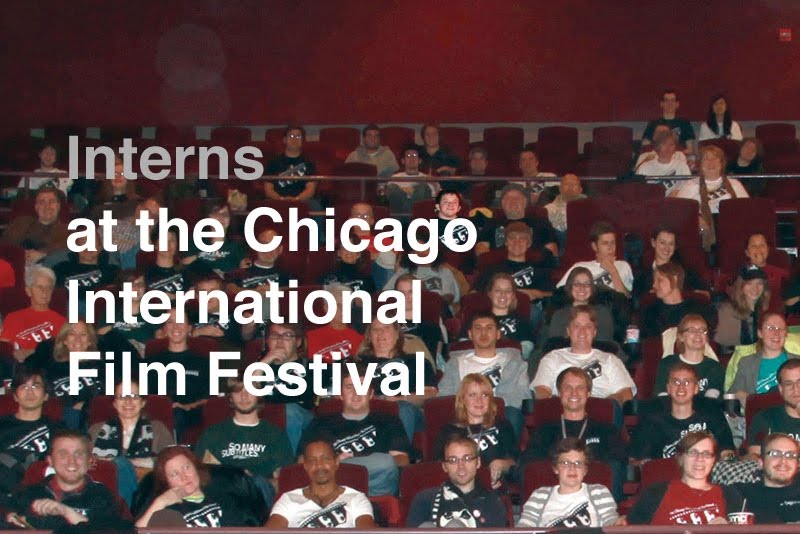
Interns, the internal machines.


The Chicago International Film Festival
October 6-20, 2011
At the AMC River East on Illinois Street

By BLAKE GOBLE

On October 6, 2011, The AMC River East on Illinois Street opened up for the 47th Chicago International Film Festival. At the very least, Chicago owes the Festival a small thank you for the diverse art brought out each year. But before sending letters to Michael Kutza, founder of the Festival, let’s take a moment to appreciate the unsung heroes of the Festival: the yearly round-up of unpaid interns.

“I’m getting paid in experience!” said Amanda Blumeyer, a current Marketing Intern.

Blumeyer is one of many unpaid interns working with a goal of bringing art to the masses. “The Chicago International Film Festival is the longest running competitive film festival of its kind in North America. I think it’s unique because they really try and bring films from all over the world to Chicago so we can see what people in other parts of the world are watching” said Blumeyer.

It’s a tough job market, but interns are grateful. “I’m really looking to gain experience right now, and CIFF was a good fit for me when I was job-searching.” according to Blumeyer.

Kara Leslie, a recent Loyola graduate, is the CIFF’s Front Office Manager and is also an unpaid intern. From putting stickers on 2,000 short film DVDs, to assisting programmers with watching movies, Leslie represents the hard, honest and sometimes seemingly trivial work that comes with an unpaid internship. “I don’t know if I can speak on behalf of all internships … but I definitely think that interns can be taken advantage of sometimes. At Cinema/Chicago, I definitely don’t feel that way. I feel respected for the work I do, and am treated extremely well.”

It is valuable experience, but it can be demeaning or draining at times. An un-named former Features Programming Intern shared that “My boss bought me lunch on my last day. That’s it. I’m almost certain no one in the office with equivalent seniority went without a dime.”

“I watched 50 feature-length submissions and typed up evaluations and recommendations for each one. In the end and despite my campaigning, no film I reviewed was screened to the public” according to the former Intern. “I think unpaid internships like mine are fairly exploitative of humanities students.”

“My time was already stretched thin, and one day I was particularly burdened with school and festival work. Weeks in advance I had been assigned to introduce one of the more prominent films and moderate the Q&A afterwards with its semi-famous director” said the Intern. “Finally after months of working I could do something somewhat important!

“When my film was ready to start, I went over to its theater. I saw my boss standing there and asked her when I should go in. She checked her timetable and told me I wasn’t scheduled to do anything, that someone else was going to introduce the film and moderate the Q&A. When I reminded her that she had assigned that job to me, she shrugged and said it was unfortunate but the other person had the job now.” Ouch.

Recently, interns from “Black Swan” filed a lawsuit against the producers over disputes involving the workload, accreditation and lack of actual pay. Fox Searchlight, the film’s distributor chose to ignore the suit, but the questions raised were heard clearly. Are interns under-appreciated? Do they deserve different or more substantial compensation?

A total snub, or a harsh truth about interning? Either way, the next time a movie is screened at the CIFF, take a minute to think and appreciate the intern that may have likely been behind it.

07 October 2011

A director's looming nightmare.

"The roof is on fire?"

“Dream House”
Rated PG-13
Universal/Morgan Creek
Now in Wide Release
1.5 out of 4 Stars

By BLAKE GOBLE

How did this happen to Jim Sheridan?

The Irish auteur has six Oscar nominations to his credit, thanks to past masterworks like “My Left Foot,” “In the Name of the Father” and “In America”. Now, after directing hip-hop huckster 50 Cent in “Get Rich or Die Tryin’”, and half-assedly helming the boilerplate thriller “Dream House,” it’s official: Sheridan is phoning it in for a pay-day. Joining other tainted greats like Roland Jaffe (“Captivity” after “The Killing Fields”), John Singleton (“Abduction” after “Boyz n’ the Hood”) and Alan Parker (“The Life of David Gale” after “Mississippi Burning”), Sheridan has fallen from grace with a hokey, awkward thriller. “Dream House” admittedly, looks great in pedigree. A lauded director, leading an all-star cast in a seemingly unique premise ought to be enough to intrigue.

Daniel Craig (“Casino Royale”) is Will, a successful publisher and family man who learns that there may have been murders committed within his idyllic home. The kick? Will may have committed these crimes, and his grasp of reality is quickly weakening.

This sounds intriguing enough. The problem is that Sheridan doesn’t have passion for the material, his characters or a need to satisfyingly answer questions. “Dream House” is lazy. The pace is slow, without building real question or a desire to answer Will’s problems. The actors - and there are some good ones in this (“The Constant Garnder’s Rachel Weisz as Will’s wife, and “21 Grams’” Naomi Watts as a suspicious neighbor) – just don’t seem to be trying. Ultimately, logic, care and patience are not part of the “Dream.” Pensive acting and plodding narrative make the accurately labeled “Dream House” capable of putting one to sleep. Once secrets are revealed, it just doesn’t matter. The same could be said of Sheridan’s once exciting, earthy directing. Maybe this isn’t entirely his fault, but one could easily have dreamed of more.

30 September 2011

Those Dirty Rooks at The Double Door

Profile: The Dirty Rooks

September 29, 2011

$7

The Double Door at 1572 N Milwaukee

BY BLAKE GOBLE

Written September 29, 2011

Lead singer Dan Stalilonis takes the stage before the third song, and swears “this song’s new. We have no good name for it yet. But it’s a good song!”

It’s true.

Dan is the front-man for The Dirty Rooks, tonight’s opener at The Double Door on Milwaukee Avenue. They’re playing a new song they’ve worked on, that doesn’t quite have a title yet. Doesn’t matter. This blues (booze?) rock band is here to share their music, a juxtaposition of countless influences that amounts to a sterling style of rock that you can dig.

Who are The Dirty Rooks? Well, begin by thinking of Bruce Springsteen, The Rolling Stones, Queen, Derek & the Dominoes, Deep Purple, Led Zeppelin, Black Oak Arkansas, Bachman Turner Orverdrive, The Black Crowes, The Faces, Eric Clapton, Sammy Hagar, and about a dozen+ other bands. Then, add some postmodernist lyrics, with feminist, theological ideas thrown in. Put a singer, two guitarists, a bassist, two back-up singers, a drummer and a keyboardist up there in front of an audience. Think of a band that’s cool with thinking of their work as something to reflect on and drink to.

That’s only a fraction of what The Dirty Rooks are about.

The Chicago-based blues-rock group. took the stage at The Double Door on a windy Thursday night in Wicker Park, and impressed the 30+ crowd of devoted music fans.

“We always love playing the Double Door. It’s a national icon” says songwriter and guitarist Grant Gholson. The Double Door is a real Chicago staple of music fare. It was an early venue for such infamous bands as Muse, Queens of the Stone Age, Wilco, Liz Phair and countless others in Chicago. Tonight, The Dirty Rooks have the pleasure of being the venue’s opening act before several other bands. The Double Door and its patrons respect and truly appreciate unique acts like the Rooks.

“There are venues that pay more for cover bands. And they’re great! But there are venues like Double Door and many others in Chicago that appreciate original music” said Gholson.

The band’s roots are in Americacorp, where lead singer Dan Stalilonis and Grant Gholson first met. They would sing songs, come up with music, and eventually form The Dirty Rooks with several other band-mates from all over the Midwest. Their post-modern blues-y vibes was palpably exciting on the DD stage.

“Grant’s got a gift for writing songs, that sound like stuff, other stuff, but it’s our music” said Stalilonis.

A beer-rock band with a message? Seems so. The band’s blustery, bluesy style is rooted in serious theology and ideologies that add a level of legitimacy to the proceedings, even if you miss it the first go-around. Gholson, the band’s chief writer is working on a PhD at Loyola in theology, and isn’t afraid to embed his ideas on society into their tunes. They explore legitimate themes like empathy, individuality, postmodernism, relationships, standing up against society, the 1960s and onward, and much more. As Gholson, the band isn’t afraid to “give meaning” to their music.

Then again, as bassist Ben Hunt says, The Dirty Rooks can be straight-up “booze rock!” …as Stalilonis, Hunt and Gholson somewhat shamefully and proudly shared, The Dirty Rooks make music that you can happily have a drink to. Not, that they condone that or anything…

The Dirty Rooks’ next show is at the Cubby Bear in Wrigleyville on October 13th. Check ‘em out. They might have a name for that solid song by then.

23 September 2011

Play every Thursday night.


The Mixer

$5

Every Thursday at 10pm.

The Playground Theater at 3209 N. Halsted

BY BLAKE GOBLE

Written September 22, 2011

In the middle of an exercise, Amanda Rountree stops the scene. Around three dozen twentysomethings have emerged from work or school (sleep) with an interest in experimenting in improvisation, both through practice and witnessing the art. The scene involves two people, who don’t know each other, front and center. One must say something mundane. The partner must reply with huge emotions, and show an ability to get up and be loud and proud on the stage. Two young improv hopefuls respond to each other over a large box being supposedly delivered to the stage. Rountree, though, freezes everything with some crucial wisdom, often forgotten in improv.

“Never try to be funny! It’s the saddest thing in the world! Let real happen.”

Half class. Half show. All improv theatre. This is The Mixer at the Playground theater, hosted every Thursday night by the Playground and alternating improv troupes, The Mixer is an open crash course in improvisation. Improv in Chicago has a legendary reputation, supported by The Second City, The iO Theater Chicago, ComedySportz, Jokes & Notes, The Annoyance Theater and many others. These shows always gift their audiences with free-wheeling sets, put together on the spot, and often they are the funniest things you can see in the city.

But improvisational theatre isn’t necessarily about being funny.

Improv is about being able to work with other actors, getting outside of comfort zones and creating pure, inventive performance pieces. Improv is specific, entertaining, and ultimately about the real world.

Rountree, a near twenty-year veteran of improv is overseeing The Mixer this Thursday evening. Originally from Louisville, Kentucky, this is only Rountree’s second round of mastering The Mixer. Chicago improv troupe Demascus Steel, is overseeing the festivities. Rountree is hosting alongside Jay Gish and David Flora, members of Steel.

“I came to Chicago four years ago. I’ve been in Louisville and Seattle” said Rountree. Rountree, like the improv she moderates, kinda fell into the gig.

“This is only my second time! Normally I teach at The Second City.”

Rountree was convinced by friends to do the event, because of the spontaneity that comes with The Mixer, and improv in general. “It’s unexpected theatre” said Rountree.

So what’s thrown in to The Mixer? You can see people train their emotions and stage ability with mixed moments. One minute, a female and male performing duo swap genders, and bemoan their relationships and families… all off the top of their heads…spontaneously. You’ll see a young man cleaning floors at a surface level, and then three performers will turn it into deep concern for their job-addicted friend’s inability to let go of the work. At The Mixer, you can see an Amish man walk into his first Foot Locker. You can even see the inexplicably amusing after-effects of the death of a dog.

The format is simple. People come every Thursday night. They participate in quick lessons, work in small groups, gain a better understanding for improv’s non-comedic qualities, and soon after, they create pure art. Sometimes, just watching a person mime the making of coffee, is much, much deeper and truer than one would think.

The Mixer is very real, and very playful.